1G stannous chloride granules
1G pure tin (shot)
25ml Distilled Water
30 Drops hydrochloric Acid
Date the bottle with dropper - it only lasts 3mo.
(You will want test solutions of Au PT and PD - 0.2G of each in aqua regia - PD in nitric only - then dilute with 100ml of dist-H2O
Turns bright blood red with iron.
Precipitates PT and PD.. z
Fume Hood -
Wheaton drip tip bottles
Addition funnel - seperatory funnel
condensors
Drop of nitric acid will show the base as the plate is very thin
- bubbles + color change.
First, add some pure gold to consume any excess nitric acid..
Add till all has precipitated - Stannous test.
Multiple washes with hot dist- water
Boil with hydrochloric acid wash
multiple hot dist-waterr washes.
Decant - dry - remelt
Leach solution - 40g of KI in 400ml distilled water - add 10g of elemental iodine
Add leach solution to plated gold - agitate constantly for 5 min.
decant liquid off with distilled rinse.
Add KOH flakes to solution KOH + I2 + I3- = KI + KIO3 at PH > 12.5 Au precipitates + base metals
Fritted glass filtration removes the metals - rinse with dw
(Add formic acid to solution to regenerate the leaching solution.
)
Wash metals with HCl - dilute? Removes base metals
Boil with hydrochloric acid (use the waste wash to
recgenerate leachin solution)
Wash with boiling distilled water
dissolve with Aqua-regia
filter
drop gold with Sodium Metabisulfite
Melt and cast
Burn off the material with torch
dissolve base metals with nitric acid
Poor off and filter off nitric acid with rinse
Add hydrochloric acid and incremental nitric acid until gold is
dissolved
Percipitate gold with Sodium Metabisulfite
Filter out gold
Wash with boiling distilled water
Boil with hydrochloric acid
Wash with boiling distilled water
Melt and cast
Melt with enough silver to quarter the gold with sterling silver
and drop in water to form granules. Press extra thin.
Put in very tall beaker Add 93% H2SO4 drain
cleaner - heat to boil 138°C
Test with a few drops into 50/50 dilute Hydrochoric acid (HCL) for silver cloride
Boil 4 hours.. cool - decant - add more H2SO4 repeat
Repeat. Total of 5 times.until no silver chloride cloud.
Rinse with distilled water
Rinse with hydrochloric acid - then heat to boil
With a add funnel - drip H2O2 hydroponics
29% - should dissolve gold.
Filter solution - stanic acid test - should see gold.
Add Sodium metabisulfite Na2S2O5
SMB (Bonide's Stump-out) until stannic test goes clear. boil
off reagents
Settle gold over-night. decant - wash
Redissolve gold - Add HCl again - heat to boil - drip H2O2
Add a few drops of H2SO4 to percitpitate out any lead.
Filter
Prepare Iron sulfate - dissolve in distilled water - add Hcl until green? filter.
add to solution to precipitate only the gold. - stannous test to be sure all gold has dropped.
Decant waste
Wash with water . Wash with Hcl multiple till clear..
You can redissolve gold a third time.. repeat.
You can also drop gold by dropping H2SO4 on
SMB/water slurry - bubble through H2SO4 -
makes SO2 gas - bubble through solution to drop the gold.
Boil to get rid of SO2 gas.
Wash one more time in HCl - then boil in HCl - decant -
wash in distled water.
Test for neutral PH Bromothymol Blue Solution
Bake at 500C
Wash with 10 - DW 10 HCL 1 HNO3 Heat overnight covered with cold cover to form a reflux - rinse DW
0.5G of Potasium dichromate + 10ml DW and 7ml of 70% nitric acid.
A drop makes some red stuff on real silver - marks the silver..
Tin - from coreless lead free solder - must be 90%+ tin
1G tin + 10ml 30% HCL - wait till dissolved..
Decant for the liquid. which is Stannous chloride is tin(II)
chloride, SnCl₂
add 100ml of silver polish that contains Thiourea mix -
heat if not clear.. Will oxidize so seal well.
200ml water + 20g NaCL (table salt) + 10G NaHCO3
Connect neg to the silver and + to the liquid..
distill off water - starts at 180C
800mL of propylene glycol - add 50ml of concentrated H2SO4
Distill with a drop every 2-3 seconds - Remove water layer with seperatory funnel
Add 40g potassium hydroxide to destroy impurities. Stir over
night -
Long column - distill off Dimethyl Dioxane - store over sodium

 3rd
Century Distillation
3rd
Century Distillation

Two types - light return vs heavy return - used for azeotropic
distilation where fractional distillation doesn't work.
Often used to remove water.
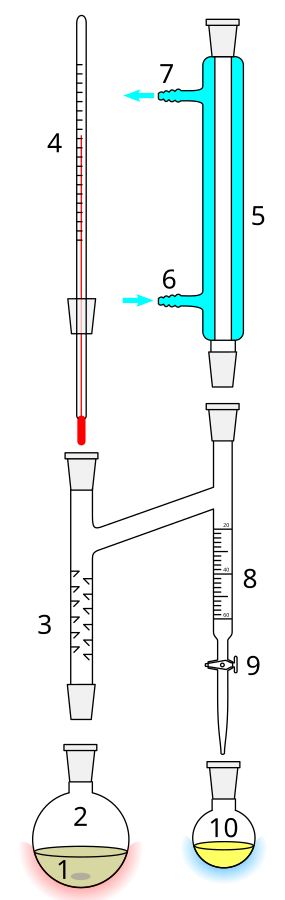
Fractionating column with a side tube that slants up to a
condensing tube. You need a solvent that doesn't bump,
splash or foam.
Provides heavy return mode - returns the lighter phase while
keeping the heavy phase.
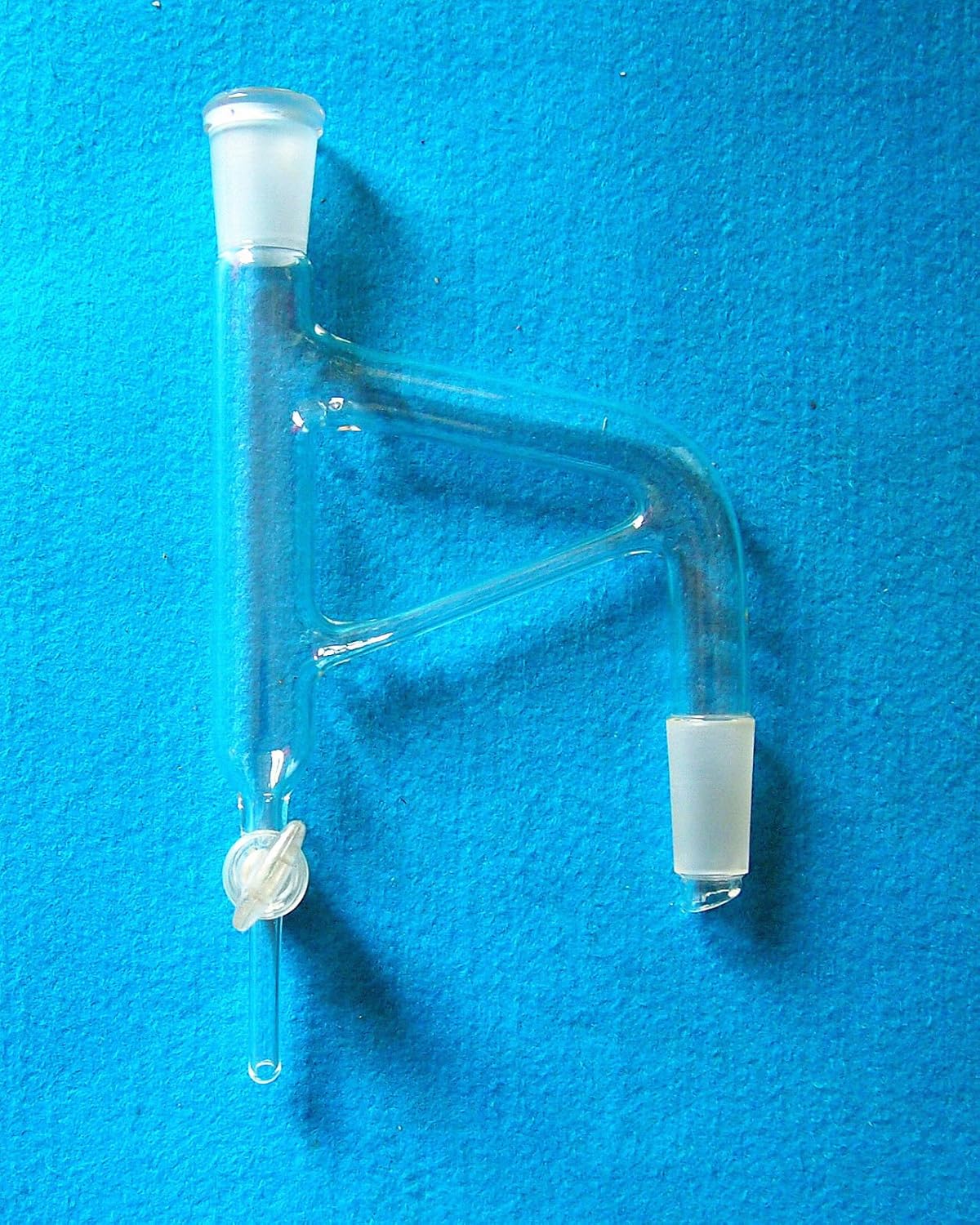
Fractionating column with a side tube that slants up to a condensing tube.
Can be used with vacuum.
Soxhlet extraction is application - desired compound has a
limited solubility in a solvent, and impurity is insoluble
in that solvent. Automates recycling a small amount of solvent to
dissolve a larger amount of material. Goes between the
boiler and reflux column.
2 mol sodium nitrate (170g) meat curing salt
2mol 98% sulfuric acid (207g)
Heat to below 200°C
Distillation - seal with teflon tape.
30g magnesium powder Mg
40g sodium hydroxide NaOH
Mix in steel container - or crucible cover with brick -prevent
oxygen - will eat sodium - ignite
2Mg +2NaOH→ 2MgO + 2Na + H2
Cover with mineral oil
300ml antifreeze - concentrate (CH2OH)2
30ml H2SO4 98% - Can be drain cleaner or
more dilute
Distillation apparatus to product start heat and cooling until starts to boil Adjust for a drop every 2-3 sec
Stop when foaming is a problem - you will have water and
side products to get rid of (clean with NaOH)
Add 10ml H2SO4 98%
Set up fractional distillation apparatus and start distilling.
Change out the receiver at 84°C
Dioxane and water have a low boiling azeotrope at 87°
Stop at 94° You will have 17.9% water and 82.1% dioxan
Add a bit of Na metal if you can - or the Sodium magnesium oxide aggregate stir over night bubbling should stop.
Distill over the dioxane. Store over sodium or NaOH if you
don't have Na metal.. (can blow up on storage otherwise.. )
From greensand iron filter regenerate
Erlenmeyer
flask insulated with foil -
14g magnesium powder
20g sodium hydroxide NaOH
2g Menthol crystals
125ml Mineral oil (hypoallergenic baby oil)
3g Na - or as Na MgO aggregate - 8g?
Magnetic stir bar
Top of flask to thermometer and bubbler - using mineral oil
prevent backflow and monitors.
Maintain 120 - 130°C This drys the NaOH via the sodium producing hydrogen - wait till 1 bubble every 10sec or slower.
Raise to 200°C - more bubbles.. 15 - 50 hr. bubbling will stop.
Set up reflux on top - add 150ml of 1,4-dioxane - boil with hard
stirring for about 2 hr. - let cool sodium should
float
Let cool - poor off through sieve to collect - wash
with mineral oil
Most convenient way:
Set up gas adapter and a pressure equalized dripping funnel.
You can buy this already made as greensand iron filter regenerant
43g of manganese dioxide, often obtained from greensand filter media, and 25g of potassium chlorate, the chemicals are thoroughly mixed. A can made of iron is chosen as the reaction vessel due to its resistance to the highly corrosive mixture.
All reagents are mixed along with 40mL of water and 60g of
potassium hydroxide. The can is placed in a furnace and heated to
400 degrees Celsius for several hours. This step involves the
oxidation of manganese dioxide to potassium manganate by potassium
chlorate, with potassium hydroxide providing essential potassium
ions and alkaline conditions. Once cooled and soaked in 300ml of
water, the solid chunks of potassium manganate are retrieved. 3K2MnO4
+ KCl + 3H20
To convert potassium manganate into potassium permanganate, chlorine gas is used. A chlorine generator comprising 45g of trichloroisocyanuric acid in 100mL water and 75mL of 30% hydrochloric acid is employed to produce chlorine gas, which is then introduced into the potassium manganate flask. The reaction results in potassium permanganate with potassium chloride as a byproduct. Once the reaction is complete, the mixture is vacuum-filtered and then chilled to separate potassium permanganate from potassium chloride and hypochlorite. The potassium permanganate crystals are beautiful black needles. The final yield is approximately 30.7g or 39%, adjusted to 52% considering the purity of the manganese dioxide used. Both crystallizations of potassium permanganate are found to be 99% pure with a 1% margin of error, confirmed through titration.
(C) Copyright 1994-2020
All trademarks are the property of their respective owners.x